
What are the main takeaways from Apestaartjaren 2020 about children and digital media
The Apetail Years (= Apestaartjaren, in Dutch apetail is the word for @) is a study of media ownership and use by children between 6 and 12 years and young people between 12 and 18 years in Flanders, conducted by Mediaraven, Mediawijs and imec-MICT-UGent every two years.
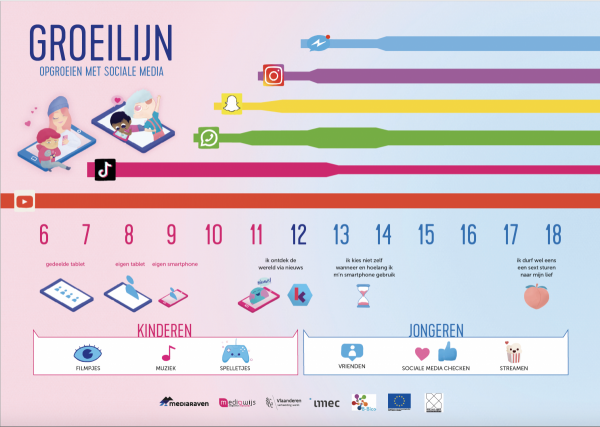
More screens, more intense, smartphone from 9 years
- Primary school children use more screens across the board in the results of Apestaartjaar 2020 than in 2018. Literally every device that was surveyed in 2018 will be used by significantly more children in 2020.
- The average age to have a first smartphone of your own shifts from 11-12 years to 9.4 years! The latter mainly has practical reasons: accessibility by and for their parents and taking nice photos of their activities (to be shown to their parents via WhatsApp or afterwards).
- Nearly half of children who use a tablet do so for more than an hour each day, on weekends. 31% say they also use it for longer than 1 hour on school days. 25% use it on weekends longer than 3 hours a day. More than half of those who use a smartphone do so every day. 37% longer than an hour on school days, 28% longer than 3 hours a day on weekends.
- 93% of young people in secondary education have a smartphone and they also use it intensively. 45% think they themselves spend too much time on their device. Almost 40% of young people cannot do a day without a smartphone.
- Supporting children in their smartphone use and social media is therefore an important task for parents and teachers from primary school.
- During their secondary education career, we must help young people to find a balance in how often they use their smartphone.
But not for everyone!
5% of primary school children do not have a laptop, tablet or fixed computer. 3% have neither one of those three devices, nor a smartphone. The latter group also never uses systems like Bingel at home and they don't do homework on such devices, unlike those who do own one of those devices at home. Children who do not have those homework devices are on average younger (more often in the first two years of primary education) and more often indicate that their own family is 'short of money to buy the things they need' (31%), than who does (17 to 24%).
6% of young people never use a smartphone. If we make a distinction between young people with Dutch as their home language and young people with a different home language, the latter 10% never uses a smartphone.
13% of the young people surveyed never use a laptop, tablet or desktop, the most appropriate devices for doing schoolwork at home. 2% sometimes use a tablet, but no laptop or desktop. The use of these devices is on average 15% lower among young people with a different home language than among young people with Dutch as their home language.
There is still a lot of work to be done on digital inclusion: it is not because you have a smartphone that you are suddenly fully digital. There is still a clear difference in access to devices to be able to do your homework at home, for example with children who are less well off at home and young people who speak aother language than Dutch at home.
Watching, listening, (Snap)chatting and TikToking ... and news?
YouTube (84%), Netflix (67%), and TikTok (44%) are the most used platforms for children. YouTube is also the most popular platform among young people. 89% of young people use it weekly. Instagram follows closely, used weekly by 82% of young people. Snapchat also belongs to that group.
Young people are not interested in news, especially about politicians and institutions. If they come into contact with news on a weekly basis, it is usually via social media (75.9%) on their smartphone. They sometimes see, hear, read news on television (54.5%), radio (52.9%) in messaging apps (49.2%) and on news websites (26.4%).
In times of fake news and influencers, we need to support children and young people in dealing with content on social media and smartphones too.
Can they turn to you?
17% of primary school children already quarrel online. 8% already used swear words and just under 5% say they have teased or bullied someone. 13% say they have already been bullied themselves (even if only 2% of the entire group indicate that it happes 'often', 'repeatedly' is an important characteristic of bullying). In the last year, 17% of youths experienced online troubles: they were harassed, mistreated, or something happened that upset them. This is the case with 21% of girls, 13% of boys. Far fewer young people witness online bullying (from 54 to 25%). That may mean that there is a bit less of such behavior, but it seems to correspond mainly to the shift to personal messages and messaging apps.
Children and young people still don't come to their parents very often, and even less to teachers with questions about smartphones, social media ... That turns out to be a vicious circle: if you only talk little about it with them, they also talk little about it when they experience issues.
Pressure and forwarding when sexting
- 17% of young people from the third stage of secondary education (16-18yo) have taken and sent a spicy picture of themselves. 8% of those did that at least once to someone they only knew online. Spicy photos are usually not completely naked. 68% of young people who have ever sexted, say that they usually make sure they are unrecognizable. Young people seem to be more aware of this now.
- 20% of the young people who sent a spicy picture, indicate that they've been pressured to do so at least once. That is much more the case for girls (31%) than for boys (9%). That is not to say that they always gave in to that.
- A third of the girls who sent a spicy image regretted it afterwards. This was only 15% for boys. Girls (21%) were more concerned that it would be forwarded than boys (11%).
- 38% of the youngsters indicate that they have already been shown or forwarded a spicy photo, without the original sender knowing about it. In 65% of cases, they know the person in the picture. 1 in 8 of those who receive such an image will forward it further. 70% do nothing with it. 10% informs the victim or confronts who forwards it.
- 10% of the children of 10-12yo have already sent a sexy photo of themselves (at least, what they find sexy ...) Of that group, 21% did this several times and 10% more often. 18% of children that age have already received such a photo. 7% of those, received it without that person's knowledge.
There is a clear need to focus more on making young people aware not to put pressure on someone to get spicy images and certainly not to forward them without permission. We should also ask bystanders to actively address people about this more.
Few good rules at home
- 18% of the children have no rules at home about their media use. Of those who do, only 25% are about what they can put online and 22% about with whom they can chat or be friends online.
- Of the nearly 4,000 young people surveyed who have their own smartphone, the vast majority indicate that there are no rules about their use at home. We see that even more among young people who have a home language other than Dutch.
- Very often people do not talk about rules at home. If rules are set, this is more often in consultation than purely imposed by the parents or guardian. Parents make more arrangements with their daughters than with their sons.
- Screen time and balance is certainly an issue that parents should teach children to deal with,
- however they should not let that slide with young people,
- they should also pay attention to what they do online and with whom,
- and above all keep talking about it and keep the channel open to report any possible trouble
- (and also think about their own conduct as a role model.)
Take a look at the results (Dutch).
 |
In the publications and products of the B-BICO project, only the opinion of the author(s) is shown. The European Union is not responsible for any use that may be made of the information contained in this publication. |
