
Migrant Liter@cies: innovative use of ICT in Literacy Teaching
Migrant Liter@cies as a project
Migrant Liter@cies was a European Strategic Cooperation project in the Erasmus+ framework from September 2017 to August 2020 in which Mediawijs together with 8 other partners from 7 other countries analyzed best practices and methodologies of adult migrant literacy programs in the countries of the partnership and developed innovative practices for language learning with the creative use of ICT, mobile devices and social media.
The project started by exploring the theme with 2 transnational Learning, Teaching and Training Activities for the project partners in Bologna and Tilburg.
National traning: Mediacoach Basiseducatie
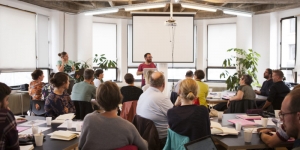 Every project partner organised national trainings for teachers and operators working with migrant adults with innovative practices, ideas and tools that promote innovative uses of ICT in Literacy Teaching and the integration of Media and Digital Literacy in migrant adult education. Together they involved 197 participants in 8 European countries.
In Belgium Mediawijs started in September 2018 with the Mediacoach Basiseducatie training. Mediacoach is a training for professionals, who mentor or educate pepole or organise education or interaction with the public and who want to integrate digital and media literacy into their own practice and organisation. A Mediacoach is the central point of contact in the school or organisation regarding media literacy and the educational use of (digital) media. The media coach inspires and supports his or her colleagues. We enlarged the initiative to a training course that continued to June 2019 and engaged 29 teachers of Basic Eduscation (literacy education for adults with low literacy).
Innovative wokshops become toolkits
Every partner developed innovative workshops in their country. All workshops were translated in English and shared among the pratners. Mediawijs developed and tested 5 workshops in Belgium.
1. Stop Motion, let’s make a movie
It is always a huge search for digital tools that can be used by students at a beginner level. But luckily Stop Motion Studio App is such an application. It is a smartphone app and video tool in one to make your own stop motion videos. We used this tool in a workshop to learn how to make pictures with a tablet, creating and telling a story and to share reflections on the things we did during class.
Download the workshop in English
2. Analysing and creating messages to empower the students
Advertisements and propaganda are everywhere. But we don’t always know they effect us. So how do we get influenced? What techniques do advertisements and propaganda use? We took our students on a little trip and learned them to analyse and create messages to understand those subtle techniques. In this workshop we learned participants to distinguish different forms of advertising and in addition they also learned strategies to recognize them. Furthermore, they learned about propaganda and the techniques that are used to create it.
Download the workshop in English
3. Parenting in digital times
Adult migrants are often also parents. And like all other parents, they rarely understand why their children find vlogs and video games so attractive. So we took them on a journey of commonly used apps and social media. In our workshop the students practiced different digital skills through questions, activities and challenges and they came up with ideas for rules about screen time in their home.
Download the workshop in English
4. Capture the neighbourhood with Lomap
It is always a huge search for digital tools that can be used by students at a beginner's level. But luckily Lomap is such an application. It is a smartphone app and photography tool in one. It is used to explore a neighbourhood in a fun and intuitive way. We used this tool in a workshop to learn to read maps, giving and following up directions and to share reflections on the things we (didn’t) like.
Download the workshop in English
5. How to recognize fake news? And what’s the importance to look critically at images?
Nowadays fake news is everywhere. But not every mistake that a journalist makes is fake news. So it’s very difficult to recognise fake news. So we did a little quiz with our participants to test their knowledge. Is it news or not? Is it fake news or not? Step by step they learned to recognize news and fake news. And they gained insight into the creation of news off and online. The participants also learned that it is important to analyse pictures in depth, because it can be a form of fake news or propaganda and not only news texts, but also accompanying pictures can tell a story and influence someone’s interpretation of a news event.
Download the workshop in English
Every partner then selected the most suitable workshops and translated them into their language to form a national toolkit.
The MOOC
All partners worked together to set up a massive open online course (MOOC) to further educate professionals on this topic. Mediawijs focused on how to get your colleagues involved.
Dissemination in multiplyer events
In 2020 each partner was organising a national multiplyer event and preparing the final European Conference in Modena, when COVID-19 struck. Our multiplyers were therefore transformed to webinars.

Partners
Migrant Liter@cies was co-funded by the Erasmus+ Programme of the European Commission as a Strategic partnership of:
- Centro Zaffiria from Italy,
- Fo.Co. Network from Italy,
- Tartu Folk High School from Estonia,
- Solidaridad Sin Fronteras from Spain
- Tilburg University from The Netherlands
- Mediawijs (imec vzw) from Belgium,
- Proacademy from Slovakia,
- JFF from Germany and
- Polis from Poland
 |
The Migrant Liter@cies project was co-funded by the Erasmus+ programme of the European Commission. |
