
European project: Mind Over Media in EU
Mind Over Media: an international project on contemporary propaganda
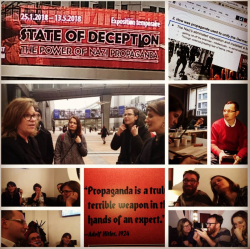 From January to December 2018 Mind Over Media ran in EU. In a consortium of 7 EU partners from Belgium, Poland, France, Finland, Romania and Croatia, we developed tools and handles to teach about contemporary propaganda, based on the work of Renee Hobbs in the Media Education Lab at the University of Rhode Island.
- Timing: 01/01/2018-31/12/2018
- Partners: Evens Foundation, Association for Communication and Media Culture (Croatia), Center for Citizenship Education (Poland), Finnish Society on Media Education (Finland), Mediawijs (Belgium), Mediawise Society (Romanië) and Media Maker / Citizen Press (France).
- Funding: ‘Mind over Media in EU’ was co-funded by Evens Foundation en de European Commission Directorate-General for Communication Networks, Content and Technology as part of the Pilot Project – Media Literacy For All Grant agreement no LC-00644630.
Finding, sharing, assessing and discussing propaganda together with mindovermedia.be
Mindovermedia.be is the Dutch translation of the interactive education website, which was developed by the Media Education Lab and Holocaust Memorial Museum in the United States. With this website you can explore contemporary propaganda in class with your students. Students and teachers can upload, rate, analyze and discuss examples of propaganda from everyday life. Students share their own examples that they find relevant. They give their own opinion about it from favorable to harmful and can discuss each other's judgment and interpretation. In this way they can formulate bottom-up which techniques play a role in propaganda and we stimulate critical thinking. You also avoid starting from top-down or one-sided interpretations and analyses.
9 teaching ideas on propaganda
Renee Hobbs from the Media Education Lab and Bert Pieters from Mediawijs developed and tested 9 lessons about propaganda, a good addition to the learning experience of the online platform www.mindovermedia.be.
The classes encourage students to:
- to discuss definitions of propaganda,
- identify common propaganda techniques,
- discuss historical and contemporary propaganda,
- examine and analyze examples of contemporary propaganda,
- find and share examples of new forms of propaganda on online media,
- share and discuss interpretations of media reports,
- consider possible beneficial, benign or harmful impacts on individuals and society,
- evaluate the context of propaganda,
- reflect on the social responsibilities of those who create and consume propaganda.
Overview lessons
- Defining propaganda: there are many definitions of propaganda, all of which contain common elements and reflect changing times and contexts.
- Recognizing Propaganda Techniques: while it can take many forms, you can identify propaganda by using techniques that arouse strong emotions, simplify ideas, cater to audience needs, and attack opponents.
- Share or Don't Share: it is important to think consciously about the potential pros and cons of propaganda when people participate in spreading propaganda through social networks.
- Where to find propaganda: it can be difficult to spot propaganda when it's hidden in entertainment, education, or the news, because we don't expect it there.
- Critically Analyze Propaganda: analyze propaganda against critical questions to identify the author, purpose and subject of the message, and look at various possible interpretations and responses.
- Make your own propaganda: in this lesson young people make their own propaganda, an active introduction to the various propaganda techniques. It is important to find out why you are convinced by a certain campaign.
- Elections and propaganda: how do the different political parties proceed to convince the voter to vote for their party?
- The power of words: words can affect us in subtle ways. Politicians, journalists, advertisers, … often try to consciously steer our thoughts and behavior with metaphors and euphemisms.
- A campaign for a good cause: propaganda rarely works immediately. Awareness campaigns and propaganda only really work if the message is repeated regularly and if the message is highly applied to a specific target group.
Browse the lesson ideas just below or download them at the bottom of the article.
Webinar: Propaganda in the classroom
Mediawijs and Kazerne Dossin each have experience in working with propaganda in an educational way. In a webinar for teachers (secondary education), students and other interested parties, we - together with the participants - examined and discussed various examples of (contemporary) propaganda and shared our educational experiences. The webinar was a collaboration between Mediawijs, Kazerne Dossin and the Special Committee for Remembrance Education and can be viewed for free below.
Media Mash-up: making your own propaganda wins European Prize for Most Innovative Media Literacy Project
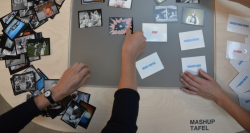 In an innovative partner project for culture of the Flemish government, JEF vzw, together with Mediawijs and Kingsberry, continued to work on Mind Over Media in EU. Media Mash-up goes further than making young people aware of propaganda and controlling media. They also use these techniques themselves to tell a positive story. Using the mashup table, they manipulate the meaning of images by placing them in a different context. They reflect on what they would like to change in their environment and turn their ideas into a stimulating propaganda film. In this way young people can take matters into their own hands and participate in the online debate.
Media Mash-up received the European Prize for Most Innovative Media Literacy Project in 2019, awarded by the European Commission. The award was launched in the context of the European Media Literacy Week 2019. Out of a shortlist of 7 projects out of 130 submitted projects, Media Mashup was chosen by a panel of experts chaired by Mariya Gabriel, European Commissioner for Digital Economy and Society, as the most innovative.
 |
''Mind Over Media: Analyzing contemporary propaganda’ forms the basis on which 'Mind Over Media in EU' was built. It was developed by the Media Education Lab (with Renee Hobbs, Kaylen Shimoda, Frank Baker, Jonathan Friesem, Sandy McGee and Lili Schlesseris) and the Holocaust Memorial Museum (with David Klevan and JoAnna Wasserman) in the United States as an educational support for the exhibition ‘State of Deception: The Power of Nazi Propaganda’. Web design and production services were provided by Night Kitchen Interactive. |
 |
'Mind Over Media in EU' was developed with the support of the Evens Stichting. |
 |
The 'Mind Over Media in EU' project is a 'Media Literacy for All' pilot project co-funded by the European Commission Directorate-General for Communications Networks, Content and Technology as part of the Pilot Project – Media Literacy For All Grant agreement no LC-00644630. The information and opinions contained in the products of this project are those of the author(s) and do not necessarily represent the official opinion of the European Union. Neither the institutions and bodies of the European Union, nor any person acting on their behalf, can be held responsible for the use that may be made of the information contained therein. |
 |
Media Mashup was created thanks to the Flemish government's call for innovative partnerships for cuulture. For this, JEF vzw worked together with Mediawijs and the digital marketing agency Kingsberry. |
Bijlagen

Links
Lees meer over
Gerelateerd


