
Children, young people and the news in 2020
The Apetail Years is a study of media ownership and use by children between 6 and 12 years old and young people between 12 and 18 years old in Flanders, conducted by Mediaraven, Mediawijs and imec-MICT-UGent every two years. In the results of 2020 we learn a lot about how young people deal with news, current events and societal debate.
How do children and young people come into contact with news?
Children and young people come into contact with news and information in many different ways, often offline through parents and friends and lessons, and also through social media, chat apps and forums and what acquaintances share there, through television, the radio, specific websites …
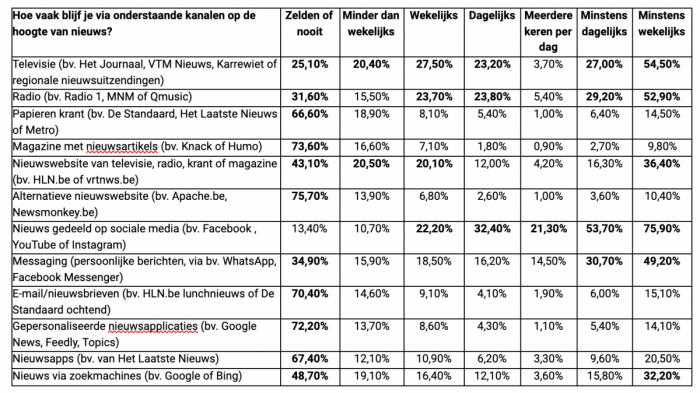
The Apetail Years 2020 shows us that social media is way ahead of the others for young people (12-18 yo) and that the smartphone is a central device for this. When we observe the news use of young people over a longer period of time - weekly - we see that news on social media (75.9%), television (54.5%), radio (52.9%) and messaging apps (49.2%) reached young people the most. During this (weekly) period, we also see that news websites (26.4%) join the list of the most used news channels.
Despite the high figures for news consumption on social media, we see a large percentage of young people who indicate that they rarely or never read news in a newspaper (66.6%), on news apps from news organizations (67.4%), in emails (70.4%), personalized news applications (72.2%), magazines (73.6%) or alternative news websites (75.7%).
What topics do they follow?
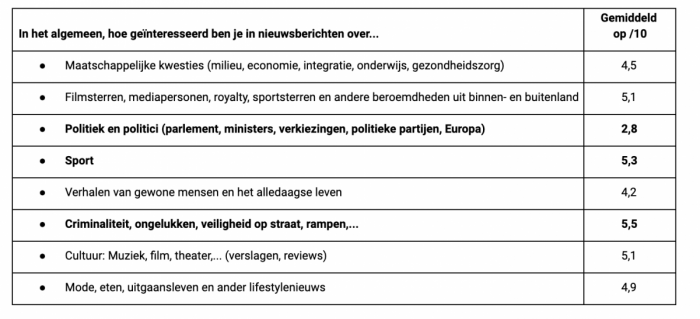
Young people also indicate that they have little interest in news, although that interest increases during secondary school.
What about their news skills and confidence?
In general, young people have a reasonable confidence in the news coverage of journalists on a scale from 1 to 5. For various indicators that reflect confidence in news reporting (eg. balanced, objective, complete), young people award an average of 3. Three quarters of young people (76.9%) did not use a paid subscription or app for digital news in the past year. Those who do use a paid subscription do so mainly through the parents' subscription (19.8%).
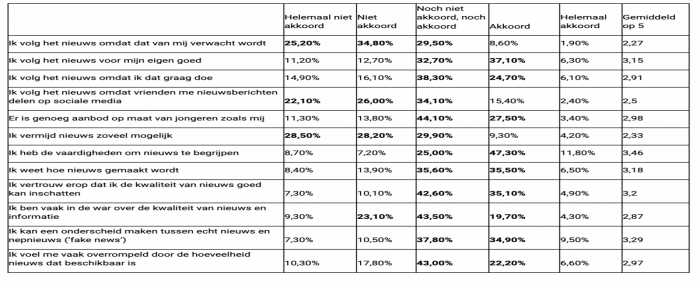
When we look at their motivation and news skills, we see that
- only a large minority of young people think news is rather important,
- only about 30% of young people think there is enough news made to their measure, but there may be too much news in general,
- a majority of young people trust that they can understand news, but most doubt whether they can rate the quality of news and recognize fake news or even think they cannot.
Participate in societal discussions online
It is interesting to see how young people deal with current social discussions online on topics such as politics and elections, migration and refugees, ecology and energy, poverty, gender and sexuality. Due to declining Facebook usage among young people, we have to distinguish between Facebook users and non-users.
Among the active young Facebook users
- almost a fourth regularly reads a post on social issues,
- three-quarters of young people sometimes read an online post, a news article or a comment on current topics.
When young people want to express their support for a social theme, indicating 'present' at a Facebook event is the most popular way.
- 15% of the young people said they do this regularly.
- 43% did it at least once in the past six months.
- 58% have never been present at such events.
A quarter of the young people have been members of a Facebook group on current social topics (25%) or signed a petition that they saw on Facebook (23%).
- 12% has frequently posted or shared something (12%)
- 8% commented in a publicly visible manner on Facebook.
- 10% post, comment or like a message in a Facebook group about those topics.
- 14% communicate about this regularly via private messages.
- 6% admit to trolling social issues.
- 69% never trolled in the past six months.
Of the young people who do not use Facebook:
- 50% have shared or even posted something public,
- 45% have liked something,
- 40% have posted something in a closed group or forum,
- 35% have responded at least once,
- 13% watched videos regularly,
- 13% post or regularly share something public,
- 10% often or very often read posts, news articles and comments on current topics,
- 9% post or even regularly share something in closed groups.
- 7% frequently check profiles of political or public figures.
Conclusions
- Young people in secondary education are not very interested in news, most of all in sports and crime news.
- They think it is not really important and that there is too much news, but not enough for them.
- They rather think that they can understand the news, but that they cannot rate its quality or whether it is real news.
- Although they think that journalists do their job okay, they get their news mainly through social media.
 |
In the publications and products of the B-BICO project, only the opinion of the author(s) is shown. The European Union is not responsible for any use that may be made of the information contained in this publication. |
Lees meer over
Gerelateerd


